

Frank Eilers | Personal Growth & Professional Insights Frank Eilers | Personal Growth & Professional Insights Frank Eilers | Personal Growth & Professional Insights Frank Eilers | Personal Growth & Professional Insights
  • The Growth Journey
    • Talent & Trade Observatory
    • Data-Driven Analysis
    • Business Strategy
    • International Markets
    • Strategic Analysis
    • Foundational Library
  • Despertando al Gigante
  • Between the Lines
  • About FkEilers
    • About Frank Eilers
  • Contact
  • English
    • Spanish
Frank Eilers | Personal Growth & Professional Insights Frank Eilers | Personal Growth & Professional Insights
  • The Growth Journey
    • Talent & Trade Observatory
    • Data-Driven Analysis
    • Business Strategy
    • International Markets
    • Strategic Analysis
    • Foundational Library
  • Despertando al Gigante
  • Between the Lines
  • About FkEilers
    • About Frank Eilers
  • Contact
  • English
    • Spanish
Nov 20
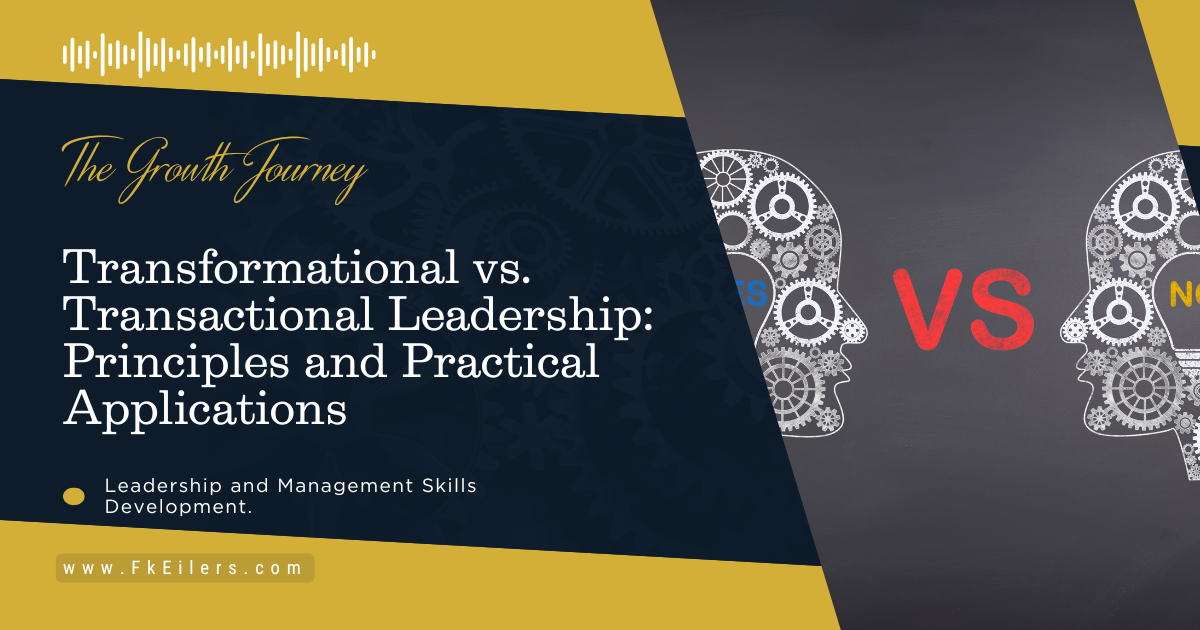
Two business leaders depicted side by side, one inspiring a team through vision (transformational leadership) and the other focusing on structured goals and rewards (transactional leadership).

Transformational vs. Transactional Leadership: Principles and Practical Applications

  • Frank Eilers
  • Management and Leadership, Foundational Library, Leadership Strategies, Success Stories from Your Network, Team Management, The Growth Journey

Leadership is a key factor in the dynamics and success of any team. But which type of leadership is more effective: transformational or transactional? Each has its principles, characteristics, and specific applications that significantly impact team motivation, performance, and cohesion.

In Transformational Leadership by Bernard M. Bass and Ronald E. Riggio, the authors describe how transformational leadership inspires and motivates beyond individual interests, while transactional leadership focuses on achieving results through rewards and clear rules. In this article, we explore the differences between both styles and their impact on organizations.

Transformational Leadership: Inspiring Change

Transformational leadership focuses on:

  • Vision and shared purpose: Leaders inspire their teams by communicating a clear vision that transcends individual goals.
  • Intrinsic motivation: They promote personal and professional development among team members.
  • Empathy and individual care: Leaders address the needs and aspirations of each team member.
  • Innovation and creativity: They foster an environment where new ideas are encouraged.

Practical Example:
A CEO leads a digital transformation by inspiring their team with a vision of how technology can enhance customer experience and drive market impact.

Transactional Leadership: Management and Results

Conversely, transactional leadership is based on:

  • Achievement of specific objectives: Employees are rewarded for meeting defined goals.
  • Establishment of clear structures: Leaders define roles, rules, and expectations with precision.
  • Control and supervision: They focus on maintaining order and ensuring tasks are completed as planned.

Practical Example:
A sales manager sets clear monthly targets and rewards top performers with bonuses, fostering performance based on metrics.

Key Differences Between Both Styles

Focus:

  • Transformational: Inspiration and long-term vision.
  • Transactional: Specific goals and immediate results.

Relationship with the Team:

  • Transformational: Close relationships emphasizing personal development.
  • Transactional: Relationships based on rules and performance.

Impact on Motivation:

  • Transformational: Encourages intrinsic motivation.
  • Transactional: Relies on external incentives.

When to Choose Each Style

There is no one-size-fits-all approach. Leaders should adapt to the organizational context:

  • Transformational: Ideal during periods of change, innovation, or when teams need inspiration.
  • Transactional: More suitable for routine tasks or in organizations with rigid structures.

Conclusion

Transformational and transactional leadership are not mutually exclusive; an effective leader can integrate elements of both styles depending on the team’s and organization’s needs. Understanding their differences and practical applications allows leaders to maximize their teams’ potential and achieve success.


  • Facebook
  • Twitter
  • Reddit
  • Pinterest
  • Google+
  • LinkedIn
  • E-Mail

About The Author

Business & Data Analyst focused on international markets, strategy and market intelligence. Founder of FkEilers and creator of The Growth Journey, where business, data, strategy and international context connect through applied judgment.

Related Posts

Comments are closed.

Categories

  • Between the Lines
  • Business Strategy
  • Change Management
  • Customer Service
  • Data-Driven Analysis
  • Data-Driven Analysis
  • Despertando al Gigante
  • Foundational Library
  • Goal Achievement
  • International Markets
  • Leadership Strategies
  • Management and Leadership
  • Marketing
  • Personal Development
  • Personal Growth
  • Self Awareness
  • Strategic Analysis
  • Strategic Planning
  • Success and Life Purpose
  • Success Stories from Your Network
  • Team Management
  • The Growth Journey

Tags

* customer-retention Artificial Intelligence Automation BiblicalInspiration Branding business strategy CES ChangeManagement ChangeStrategies Chatbots customer-service Customer Experience Customer Journey Customer Lifetime Value Customer Loyalty Customer Success Customer Support Customer Trust decision making DespertandoAlGigante Digital Marketing EffectiveLeadership Experiencia del Cliente FaithAndPurpose Leadership LeadershipSkills LeadershipStrategies LifePurpose Marketing Marketing Analytics Marketing Strategy Motivation NPS OrganizationalTransformation PersonalGrowth PurposeDrivenLife SelfDiscovery SEO Service Culture Servicio al Cliente SpiritualGrowth Strategic Marketing Success TransformationalLeadership Value Proposition
© 2026 Frank Eilers. All rights reserved. FkEilers | Privacy Policy | Terms and Conditions