



On Artificial Intelligence, Learning, Judgment, and Responsibility
Not long ago I watched a video about artificial intelligence, writing, and thinking that made me uncomfortable. Not because it argued that we should stop using these tools, but because it touched a question that, in my case, was no longer abstract. I use AI to research, organize ideas, review arguments, develop systems, and work on texts and solutions that, without that assistance, would require far more time, money, or people. For a moment, the question became unavoidable: how much of all this am I really doing myself?
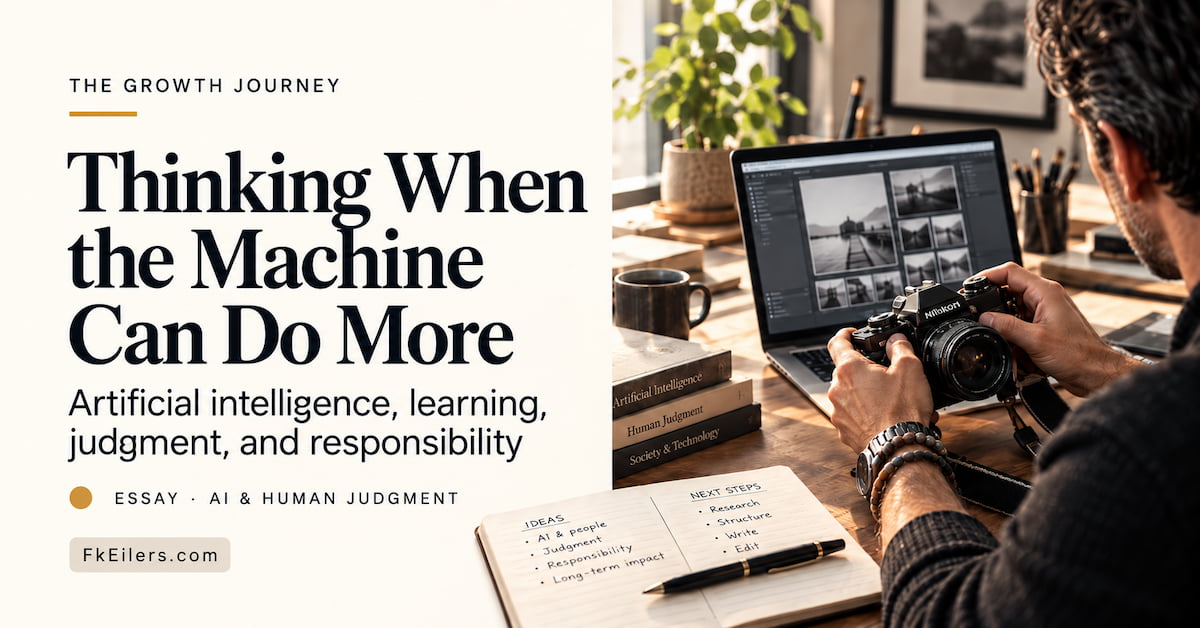
Thinking through those questions, I remembered that something similar had happened to me many years earlier, when I began studying photography and the transition from analog to digital was still met with considerable suspicion. I shared some of that skepticism. A camera that automatically handled part of the exposure, or an image later edited in Photoshop, seemed to take something away from the photographer—as if the technology were doing too much on their behalf. There was a sense that someone who relied too heavily on those tools was, somehow, less of a photographer. Today I recognize an echo of that suspicion in some conversations about artificial intelligence: if a tool does a significant part of the work, it becomes easy to wonder how much of the capability really belongs to the person using it.
That is why, when someone asked me what camera they should buy if they wanted to learn photography, I used to answer with another question: “Do you want to make the photograph yourself, or do you want the camera to make it for you?” The intention was simple. If you wanted to learn, it was not enough to leave everything on automatic; you needed to understand what was happening, why one decision produced a particular result, and what could be done differently. For a long time, that seemed like a useful distinction. Over the years, I came to understand that it was also incomplete.
Street photography taught me something else. There, you never fully control the scene: you do not decide who will turn the corner, what expression will appear for half a second, or how the light will change. Some photographs contain luck, but experience changes the way that luck finds us. Over time, we learn to read the space more carefully, anticipate, wait, and react. A good photographer does not control everything that happens; they develop a more refined ability to recognize when something is happening and decide what to do with it. That correction became important to my thinking about AI: competence does not mean personally executing or controlling every operation.
Producir mejor no significa comprender mejor
Still, a good result is not enough. A fortunate photograph does not automatically make someone a good photographer, just as a brilliant AI-generated answer does not by itself show that the person receiving it understands the problem. While exploring this distinction, I came across a study by Hamsa Bastani and colleagues involving mathematics students. The students could perform considerably better while using GPT, but one configuration later produced worse results when they had to take a test without the tool; another configuration, designed as a tutor with stronger guardrails, avoided that penalty.
I do not think that allows us to conclude that AI necessarily harms learning. The setting was educational and specific. What it did help me see more clearly is that assisted performance and independent capability are not necessarily the same thing. We can produce something better while a tool is available without having developed equivalent understanding. That reached directly into my original question: perhaps part of the problem is not that AI does a great deal, but that we confuse what we can produce with it with what we actually know how to do or understand.
The research also corrected my intuition in the opposite direction. Noy and Zhang found that ChatGPT reduced the time required for certain professional writing tasks by around 40 percent and increased the rated quality of the results by about 18 percent. Brynjolfsson, Li, and Raymond, working with data from more than five thousand customer-support agents, also found productivity gains, especially among less experienced workers. That forces us to abandon another overly simple idea: removing effort is not necessarily a bad thing. There is no special merit in spending four hours on something that can be done well in forty minutes.
Cuando el pensamiento cambia de lugar
The question then began to shift. It was no longer about protecting manual work from automation, but about distinguishing which parts of that work supported an understanding we still needed to preserve. A Microsoft Research study based on a survey of 319 knowledge workers and 936 self-reported examples of AI use was particularly useful to me. In the qualitative analysis, participants described part of their cognitive effort shifting toward verifying information, integrating responses, and overseeing the process. The tool could do more without demonstrating that thinking had disappeared; it could change where some of that thinking took place.
El problema de saber cuándo confiar
As I continued researching, I found an experiment by Fabrizio Dell’Acqua and colleagues involving 758 Boston Consulting Group consultants that illustrated the difficulty especially well. On tasks that fell within GPT-4’s capabilities, participants using AI completed more work, did it about 25 percent faster, and produced better results. But on a task deliberately chosen outside that frontier, AI users were less likely to reach the correct solution.
The uncomfortable part is not discovering that AI can be wrong; we already know that. The difficult part is recognizing when we are precisely in one of those situations. If a tool works extraordinarily well nine times, what allows us to detect the tenth time when we should not trust it? And if, on some tasks, it can outperform our own execution, how do we prevent that apparent superiority from making us less able to recognize its mistakes?
That is where I began to see the problem differently. Working with AI is not only about knowing how to ask for something. It also requires knowing when to trust, when to check, when to question, and when to admit that we do not know enough to judge what is in front of us. The more capable the tool appears, the more important that ability becomes, because fluency can look too much like reliability. The challenge stops being to prove that we can still execute every part of the work ourselves and becomes one of preserving enough understanding to evaluate what we are accepting.
For me, the question of authorship sits inside that problem rather than above it. Detecting who produced the sentences is not the same as detecting who produced the thought; but having requested those sentences does not prove that the thought is ours either. Between an idea and a published text there may be experience, research, changes of position, structure, editing, and final judgment, and AI can participate intensively in several of those stages. The question that interests me more is not how many words I personally typed, but what intellectual contribution stood behind them and what I am actually prepared to defend.
Delegar sin dejar de comprender
That brought me back to an idea I learned long before working with artificial intelligence and have tried to apply whenever I have been responsible for leading people. I have always tried not to ask for work that I do not understand at least well enough to know what I am asking for, what result I expect, and when something may be wrong. That does not mean knowing more than the specialist; I turn to a specialist precisely because they know more than I do. But delegating does not mean walking away from the result. With AI, that tension becomes more visible because I can now delegate in seconds tasks that once would have required several people.
The question that ended up accompanying me throughout this reflection was therefore a different one: what level of understanding corresponds to the level of responsibility I am assuming? It will not be the same when correcting an email as when accepting an analysis on which an important decision depends. Nor do I think there is a universal rule that can tell us exactly what we should preserve and what we can externalize. But I find it increasingly difficult to separate responsibility completely from understanding.
The old photography question returns, then, with a different meaning. “Do you want to make the photograph yourself, or do you want the camera to make it for you?” Today I would say it was a useful question, but an incomplete one. I do not need to control every mechanism of the camera to make a photograph, nor do I need to personally execute every operation that an AI system can perform better or faster than I can. What I do need to preserve is what allows me to recognize what I am looking at, interpret what is happening, judge when something does not fit, and answer for the decision I make.
Perhaps the question is no longer whether I can prove that I am still thinking. The question is whether I can build a way of working that requires me to keep doing it.
References
- Bastani, H., Bastani, O., Sungu, A., Ge, H., Kabakcı, Ö., & Mariman, R. (2025). Generative AI without guardrails can harm learning: Evidence from high school mathematics. Proceedings of the National Academy of Sciences, 122(26), e2422633122. https://doi.org/10.1073/pnas.2422633122
- Noy, S., & Zhang, W. (2023). Experimental evidence on the productivity effects of generative artificial intelligence. Science, 381(6654), 187–192. https://doi.org/10.1126/science.adh2586
- Brynjolfsson, E., Li, D., & Raymond, L. R. (2025). Generative AI at Work. The Quarterly Journal of Economics, 140(2), 889–942. https://doi.org/10.1093/qje/qjae044
- Lee, H.-P., Sarkar, A., Tankelevitch, L., Drosos, I., Rintel, S., Banks, R., & Wilson, N. (2025). The Impact of Generative AI on Critical Thinking: Self-Reported Reductions in Cognitive Effort and Confidence Effects From a Survey of Knowledge Workers. Proceedings of the 2025 CHI Conference on Human Factors in Computing Systems, Article 1121, 1–22. https://doi.org/10.1145/3706598.3713778
- Dell’Acqua, F., McFowland III, E., Mollick, E., Lifshitz, H., Kellogg, K. C., Rajendran, S., Krayer, L., Candelon, F., & Lakhani, K. R. (2026). Navigating the Jagged Technological Frontier: Field Experimental Evidence of the Effects of Artificial Intelligence on Knowledge Worker Productivity and Quality. Organization Science, 37(2), 403–423. https://doi.org/10.1287/orsc.2025.21838

Comments are closed.